

The Paper Industry Requires Support for Self-Sufficiency in Production
Mr. Vu Ngoc Bao, Secretary General of the Vietnam Pulp and Paper Association, stated that the paper industry in Vietnam still largely relies on imported pulp materials.
On the afternoon of November 22, in Hanoi, the Light Industry Department (Ministry of Industry and Trade) and the Industrial Paper and Cellulose Research Institute Co., Ltd. held a seminar to gather expert feedback on the draft “Development Plan Adjustment for Vietnam’s Paper Industry until 2020, with Consideration for 2025.”
If the paper sector’s investment projects proceed on schedule, the entire industry could reach an output of around 2.8 million tons per year. Given the domestic demand of approximately 2.2 million tons, the paper industry could have an excess of pulp for export.
However, there are still significant challenges facing the paper industry. Firstly, government support remains unclear, with policies that often treat both large and small enterprises equally; this complicates the establishment of paper mills, as many localities refuse to approve sites due to environmental concerns.
This is partly a consequence of outdated production technology among small- and medium-sized enterprises, where wastewater treatment systems are underfunded. The second major obstacle is the capital investment requirement; low-budget facilities cannot meet technological standards.
According to Mr. Bao, today’s consumers only choose high-quality products, meaning that paper manufacturers need both substantial capital and experience. In the paper industry, an inexperienced investor may take up to two years to fine-tune production metrics, even after machinery is installed. Facing such challenges, many manufacturers are struggling to sustain operations. The rising cost of imported raw materials has even pushed local manufacturers to raise product prices above those of imported paper.
At the seminar, numerous companies expressed concerns about plans to reduce raw material consumption and set competitive pricing strategies to mitigate trade deficits and curb inflation. However, achieving these goals requires substantial government support, especially in afforestation and securing raw material supplies.
According to representatives of the Industrial Paper and Cellulose Institute, with total new and expanded investments amounting to USD 12.897 billion by 2015, Vietnam’s paper industry could achieve a pulp production capacity of 3.5 million tons per year and a paper production capacity of 10.5 million tons per year. This would enable the production of 5.8 million tons of paper, meeting 80-83% of domestic market demand.
Additionally, the revised plan leverages regional strengths across the country, notably in mountainous and ethnic areas, by encouraging economic development through afforestation for paper production.
The development plan highlights investment in both raw material zones and paper and pulp manufacturing in regions such as Northern Central Vietnam, Northwest, Northeast, Thanh Hoa, Central Coast, Central Highlands, and Southern regions. This will create jobs and income opportunities for thousands of mountain farmers, promoting industrialization and modernization in rural areas and gradually shifting the economic structure toward increased industrialization.
Thus, this approach is seen as a high-growth option, consistent with the investment capacity of Vietnam’s paper industry and the country’s overall growth trajectory, while also being feasible for implementation.
Given the unique social importance of paper as a high-demand product with distinct technological, equipment, production, and investment needs, industry experts and associations have called on the government to adopt favorable policies to attract foreign investment into pulp production and processing through 100% foreign-owned investments, joint ventures, and partnerships.
Furthermore, the government should facilitate access to credit and ODA development loans for the establishment of raw material areas to ensure stable supply for mills. It is especially critical that government policies encourage and support businesses and households in adopting new, high-yield tree varieties for afforestation, enhancing forest productivity, reducing product costs, and ensuring competitiveness.
Giấy dó từ lâu đã gắn liền với lịch sử văn hóa, nghệ thuật và thủ công truyền thống của người Việt. Giữa thời đại số hóa và sự lên ngôi của các loại giấy công nghiệp hiện đại, loại giấy làm từ vỏ cây thủ công này vẫn giữ một vị trí đặc biệt.
Bài viết này sẽ giúp bạn hiểu rõ bản chất giấy dó là gì, quy trình làm ra chúng cũng như giá trị thực tiễn và khả năng ứng dụng của giấy dó trong đời sống hiện đại.

Khi những xu hướng thiết kế hiện đại đang dần bị bão hòa bởi các chất liệu công nghiệp như fomat, mica hay nhựa tổng hợp, sự xuất hiện của triển lãm "Cóc Cốc Tùng Tùng" tại Đình Sơn Trà giống như một khoảng lặng đầy bất ngờ. Trái tim của không gian trưng bày năm nay — cụm tác phẩm "Cóc kiện trời" khổng lồ cùng hệ thống 21 chiếc lồng đèn thủ công — hoàn toàn được dựng lên từ những vật liệu cơ bản nhất: tre, trúc và giấy dó.
Dưới lăng kính của những người làm nghề và nghiên cứu vật liệu, đây không đơn thuần là một sản phẩm trang trí mùa lễ hội, mà là một bài toán kỹ thuật thực thụ về sức chịu lực và cấu trúc tạo hình.
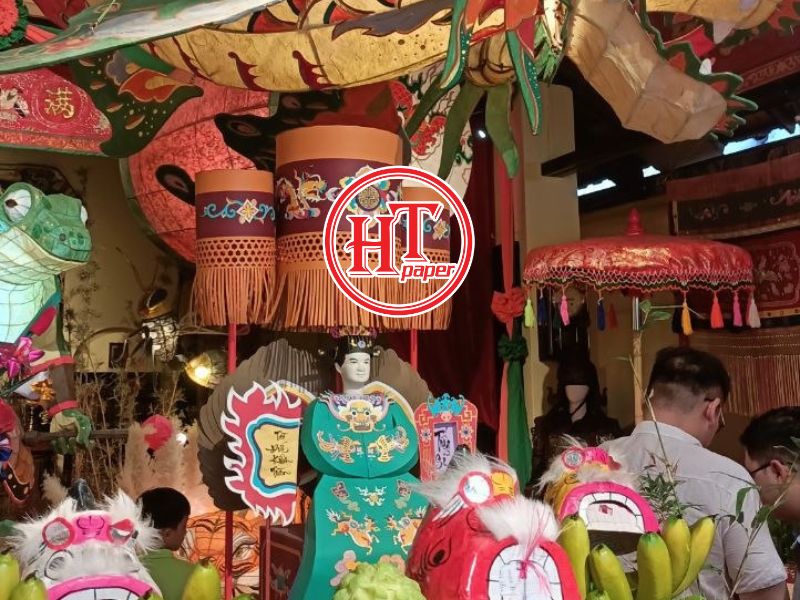
Giữa nhịp sống hối hả và có phần ngột ngạt của Sài Gòn, có những chốn dừng chân dường như tách biệt hoàn toàn với bên ngoài. Bước qua cánh cổng của ngôi đình cổ hơn 160 năm tuổi – Đình Sơn Trà trên đường Nguyễn Phi Khanh (quận 1) – cái nóng và tiếng xe cộ ngơ ngác lùi lại phía sau. Đón lấy chân mình là khoảng sân rợp bóng mát, nơi sự kiện triển lãm nghệ thuật Trung thu mang cái tên ngộ nghĩnh "Cóc Cốc Tùng Tùng" đang diễn ra.